Cruel City: A Novel by Mongo Beti
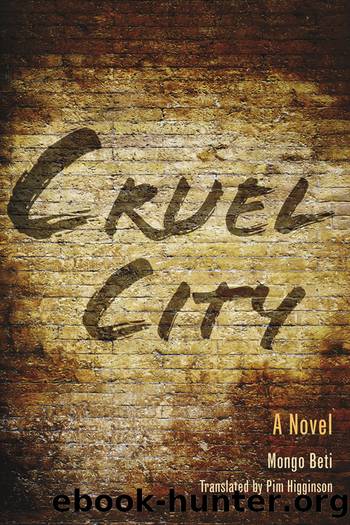
Author:Mongo Beti [Beti, Mongo]
Language: eng
Format: epub
Publisher: College of Law Publishing
Published: 0101-01-01T00:00:00+00:00
âFRANCE AND THE BLACKSâ BY JEAN GUÃHENNO6
This is a tiny little book of 140 pages that appeared in 1954. No pretension. Jean Guéhenno is an intellectual whose responsibilities as an educational inspector have brought him into contact with Black Africa. Mr. Guéhenno is not a journalist: thus his book is not a newspaper article (though it should be noted that his impressions all appeared in serial form in Le Figaro littéraire). Nor is it really an essay. So what is it? This book doesnât want to belong to any of the traditional categories, and that isnât a fault; rather the contrary, it is something commendable. To summarize, he reveals a French intellectualâs impressions of Black Africa: the destiny, present and future, suggested to someone with the sort of generous heart occasionally found in our times. In introducing his book, Mr. Guéhenno says in most heartwarming fashion: âOne hears a great deal said about the âFrench Union.â It is a legal, economic, and political fact. One should be willing to admit that it is not yet a human fact since it is not yet in the hearts of men, whether Black or White. I only hope that these notes, as paltry as they may be, help in giving this âFrench Unionâ life.â
The author has been through and around a good portion of French West Africa. He has visited many places: Dakar, Bamako, Bobo-Dioulasso, Ouagadougou, Niamey, Lomé, Abidjan. He has observed, he has meditated, and he now gives us the fruits of these meditations on his observations. And, it should be said that it is a very good read. But as I was saying earlier, one should have no illusions about this kind of work, and Guéhenno himself recognizes this fact: âI am under no illusion,â he says on page 56, âabout what is artificial in this kind of a voyage. Having completed my dayâs work, today in two hours I was able to see, for my amusement, the market, the governmental palace, the river and its port . . . the biggest café where the Whites get married and unmarried and so on and so forth. We fly through the air, we run along the trails. We are now on our ten thousandth kilometer . . . I donât know what good I will have done for humanity, but I fear that upon my return, though innocent, I will have the Green Cross at my heels.â
It is true that Guéhenno spares neither natives nor Europeans. Heâs even honest enough to admit that: âIn Dakar one feels no human warmth. Blacks and Whites are brought together there despite themselves, incapable of looking at each other. I can barely breathe. As soon as I am free, I escape . . .â And later: âOne becomes obsessed here with the problem of racial confrontation. Perhaps there is no solution to it . . .â But in the final analysis? The colonizer and the bourgeois close the book with a conscience even clearer than before. I, for my part, close this book with rage because I feel I have been duped.
Download
This site does not store any files on its server. We only index and link to content provided by other sites. Please contact the content providers to delete copyright contents if any and email us, we'll remove relevant links or contents immediately.
The Fine Print (Dreamland Billionaires Book 1) by Lauren Asher(2576)
Fury of Magnus by Graham McNeill(2460)
The Last House on Needless Street by Catriona Ward(2421)
The Rose Code by Kate Quinn(2234)
A Little Life: A Novel by Hanya Yanagihara(2182)
The God of the Woods by Liz Moore(1970)
Malibu Rising by Taylor Jenkins Reid(1943)
Luster by Raven Leilani(1911)
Transcendent Kingdom by Yaa Gyasi(1871)
Moonflower Murders by Anthony Horowitz(1865)
The Lost Book of the White (The Eldest Curses) by Cassandra Clare & Wesley Chu(1720)
This Changes Everything by Unknown(1516)
The Midwife Murders by James Patterson & Richard Dilallo(1501)
The New Wilderness by Diane Cook(1453)
The Lying Life of Adults by Elena Ferrante(1443)
Wandering in Strange Lands by Morgan Jerkins(1437)
Written in the Stars by Alexandria Bellefleur(1417)
Ambition and Desire: The Dangerous Life of Josephine Bonaparte by Kate Williams(1405)
The Lying Life of Adults by Elena Ferrante;(1321)
